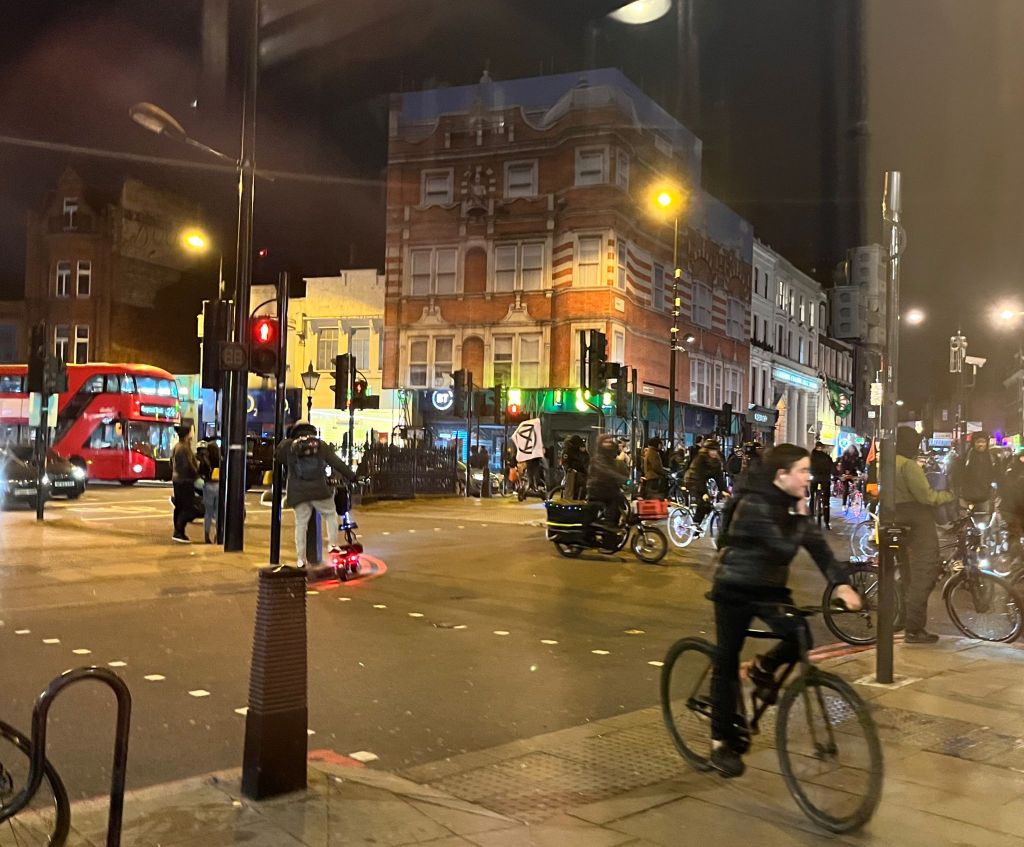
Climate activists have raised considerable public attention by blocking highways, disrupting sporting events, throwing tomato soup at paintings and more. Despite the attention, the activism seems to generate mostly negative sentiments amongst wider parts of society. By disrupting public life, groups like Extinction Rebellion or Just Stop Oil mean to raise awareness for the climate crisis. The fact that activists like them do not always present a clear message or demand, may be because they want to encourage wider participation. Nevertheless, it is clear that they have been unsuccessful in winning over the public. Anecdotally, whenever their antics are brought up in conversation, the typical responses we have witnessed tend to be eye-rolls and groans rather than a serious consideration of their message. This is supported by a recent YouGov poll which indicates that Extinction Rebellion are only liked by 12% of the UK population, and disliked by 54%.
But why do the actions of climate activists lead to such negative sentiments in the first place? Are they not serving a purpose that reasonable citizens should find relatable? Moreover, has climate activism really failed, and finally, does public opinion matter when it comes to achieving tangible outcomes for the environment?
Two concerns
Implicit to these questions, there is a concern that the polarising effects of climate activism will overturn their benefits. To clarify this, we should distinguish between the short and long term transition to a sustainable society. In the short term, raising awareness by ‘radical’ action can open a window of opportunity to implement change in top level politics. The burst of attention can be a spark of momentum to align political actors, formulate a demand and face the conservative centre of power- for more information, see the Multiple Streams Approach in the study of public policy. In the Netherlands, a series of highway blockings was followed by a setback to initial government plans to reduce excise duties on petrol.
In the long term, a sustainable society requires action of another sort. A truly sustainable society demands a change of daily behaviour, a reappreciation of our relationship with nature, a green conception of the good life, a novel model of the economy etc. For all these changes to be durable and legitimate, they should be widely supported by the public. This asks for a culture of unity and compassion.
To illustrate the previous distinction, consider that industrialist and campaigner Dale Vince stopped funding Just Stop Oil for similar reasons. He funded over £340,000 to the organisation but decided to redirect his resources to a campaign aimed at getting young people to vote. However, he did not give up his fight for a green economy. Instead, he believed that under the current UK government, climate activism supports the Conservatives. The negative attention generated by climate activists fuels the Tories’ campaign against ‘green wokery’. Instead of spreading the scientific consensus on the need to stop extracting fossil fuels, their actions may reinforce a political division.
On another note, we fear that the public debate is dominated by two rigid views. On the one hand, one can appeal to the need for civil disobedience. Simply put, if you want to change the law or the system, naturally you need to breach or disrupt it. Empirically, social or political revolutionary changes typically started with radical action. Vince also says that the more disruptive climate protests are, the more effective they will be. Yet, the social relations and structure of society (for Vince, the conservative-dominated politics) can bring this law out of balance. On the other hand, those who are critical of (radical) climate activism, simply argue that no one is above the law whatever cause you support. By undertaking activism that is not allowed for legally, one is breaching the law and wasting police resources.
Moral superiority
The unpopularity of climate activists is, in a broader sense, related to the disruption they cause; blocking roads and stopping trains simply annoys people, and this is enough to turn people against them. It is not only the actions of the protestors, however, but the actors themselves. Climate activists, in the most part, tend to be predominantly white and middle-class. Furthermore, they sometimes tend to convey an aura of morally superiority, as if to say ‘if we can do it, why can’t you?’ An organiser of Extinction Rebellion gave an answer to this effect when asked by a journalist about the disruption the group were causing. The organiser, Gail Bradbrook, said about those affected: ‘they should take some time off work and come and join us.’ Clearly, such a comment is out-of-touch, ignoring the struggles that most people have to endure to financially support themselves and their families. These people cannot simply ‘take some time off work’ to block roads or glue themselves to buildings. In addition to the immediate financial impact of missing a day of work, these actions can also lead to arrests which can carry fines, prison sentences, and criminal records, thus impacting job prospects and future income.
The unpopularity of climate activists, therefore, can be explained to a significant extent by their middle-classness and air of moral superiority, which unsurprisingly fails to resonate with the working-class sections of the public. However, it may be the case that the reason for the unpopularity of climate activist groups could also be their strength. Being white and middle-class comes with many unjust privileges. This includes wealth, of course, but also the ‘benefit of the doubt’ when it comes to past actions; employers would likely give more favourable treatment to a white, middle-class person with a criminal record than a black, working-class person with one. Therefore, the cost of radical environmental activism is significantly lower for some than for others.
This perhaps makes clearer the strategy of the likes of Extinction Rebellion and Just Stop Oil; they are not trying to gain popularity, but instead to disrupt the state apparatus to the extent that the state has to listen to them. Consequently, they do not need the majority of the public on their side; they just need enough people who are willing to ‘sacrifice’ themselves for the cause. And, although not insulated entirely, those in a comfortable financial position are much better placed to make such sacrifices.
This is not to say that activists merit any claims to moral superiority, however. The fact that they are best-placed to act perhaps places a moral duty on them to do so. Given that the risk for disadvantaged people and minority groups to disobey the law is so great, they can be forgiven for not doing so, even though the cause is so important. For those without these constraints, however, there are fewer excuses for remaining silent.
Moral duties and responsibilities
Despite this, the unpopularity of climate activists is still an issue – if they are actively resented by the working class, this may turn the latter group against the cause of environmentalism all together. This problem, we believe, is a failure of the middle class to acknowledge their disproportionate ability to make sacrifices that may harm them financially – sacrifices that the working class cannot afford to make. This failure leads people to conclude that the middle class are fighting their own privileged fight against climate change, one that is necessarily in conflict with working class interests. Hence, environmentalism is not a cause that the public can unite around.
The solution, therefore, is to demonstrate that all classes are on the same team in the fight against climate change. As we have established, the sacrifices people are willing to make to produce positive tangible outcomes for the environment is largely dependent on their socioeconomic status. Thus, it needs to be made clear that working class people are not expected to risk their financial security for the cause of environmentalism. So far, this has not been articulated well by climate activists, with the aforementioned quote from Gail Bradbrook a prime example of the unrealistic expectations that are being conveyed to working class people.
As in team sports, each player has a role that is unique to them but complementary to the other members of their team, with everyone aiming to achieve the same outcome. In the case of environmentalism, people who do not have the capability to make financial sacrifices can still help the team with smaller actions: reducing their use of plastics, using public transport, or walking instead of driving etc. Although these actions alone are not enough to turn the tide of climate change, it can complement the ‘bigger’ actions made by middle class activists.
Therefore, with their smaller actions, working class people are helping the environmental cause, but their actions are insignificant without bigger sacrifices being made by middle class activists. As a result, they should be happy that others are making the necessary sacrifices that they themselves cannot afford to make. This is not to blame the working class for their failure to acknowledge this, however. To reiterate, the failure is primarily one of activists failing to communicate the respective distribution of moral duties of those in different socioeconomic strata. If everyone was clear of what is expected of them, it would be easier to see how different types of actions are in aid of the same cause.
Of course, for bigger actions to be effective, they must necessarily be disruptive, therefore working class people will suffer from the actions of climate activists – this cannot be avoided. However, people would probably respond with less anger towards activists if they recognised their actions as sacrifices made by members of their own team, rather than by privileged people playing a different sport.
 Mores
Mores 
Leave a comment